From the July/August 2026 issue of Apollo.
Ferdinand Georg Waldmüller’s innovative landscapes and rebellious nature put him at odds with the Austrian art establishment of his day. Arnika Groenewald-Schmidt of the Belvedere explains what makes him so radical.
Ferdinand Georg Waldmüller is hardly a household name, especially outside his home country of Austria. There is only one work that we know of by the artist in a UK collection: a lively genre scene, The Grandmother’s Birthday, that was bought by Prince Albert for Queen Victoria when the artist visited England in 1856. But he was, for a time, one of the most sought-after artists of Biedermeier Austria. This period, which we date from the Congress of Vienna in 1815 to the revolutions that took place throughout Europe in 1848, is – like many of the artists who embodied it – relatively little-known, especially when you consider the popularity and fame of many Austrian artists who came afterwards, such as Schiele and Klimt. Amid the relative stability that returned to Europe after 1815, an affluent bourgeoisie grew in Austria, and many of them started commissioning portraits, buying paintings and seeking new kinds of furniture to decorate their homes.
The term Biedermeier was coined in a derisive sense, after Papa Biedermeier, a pompous, boring character who appeared in the German satirical magazine Fliegende Blätter – and much of the art that was produced during the time has elements of sentimentality or kitsch. This element is perhaps most visible in some of Waldmüller’s genre scenes, which feature happy, smiling children with rosy cheeks. But if Waldmüller was an artist of his time, to call him a Biedermeier artist is not quite right, because it doesn’t give credit to how innovative he was as an artist and the extent to which he followed his own path.
Waldmüller’s commitment to independent thought got him in trouble throughout his life. Having learned his trade at the Academy of Fine Arts in Vienna, he made money by painting miniatures and theatre sets before, in the 1820s, he had his breakthrough. In 1823 he painted a portrait of Beethoven; four years later he received his first royal commission, to paint two portraits of the Holy Roman Emperor Francis I; and then in 1829 he became custodian of the Academy’s art collection, which came with the title of professor. (This was not officially a teaching role, though Waldmüller did use rooms in the Academy to give private lessons.) But fast-forward to the late 1850s, and Waldmüller was almost bankrupt, desperately trying to sell his paintings, having been forced to retire early from his post.
The main cause of this was a long-running feud between Waldmüller and the Academy, which was rooted in his dogged insistence that painting should not seek to idealise but should always be true to nature. In 1846 he published the first of a series of pamphlets criticising the Academy and setting out his ideas for reform: there should be fewer students admitted, he wrote, and the Academy should invest more in a select few who actually have hopes of making it as a painter. The large, general classes should be replaced with smaller, focused masterclasses, and the focus of these should be painting from nature. He concluded that, were this kind of masterclass system to exist, then there would be no need for the Academy at all.
The moment that Waldmüller credited with his devotion to realism was sketched out in a biographical introduction he wrote in the 1847 reprint of his proposals. In 1819 he had been commissioned by Captain von Stierle-Holzmeister to paint a portrait of his mother as she was in real life. The portrait, which includes details such as a little wart next to the woman’s nose, now resides in the Alte Nationalgalerie in Berlin. Waldmüller saw this commission as the moment the scales fell from his eyes.
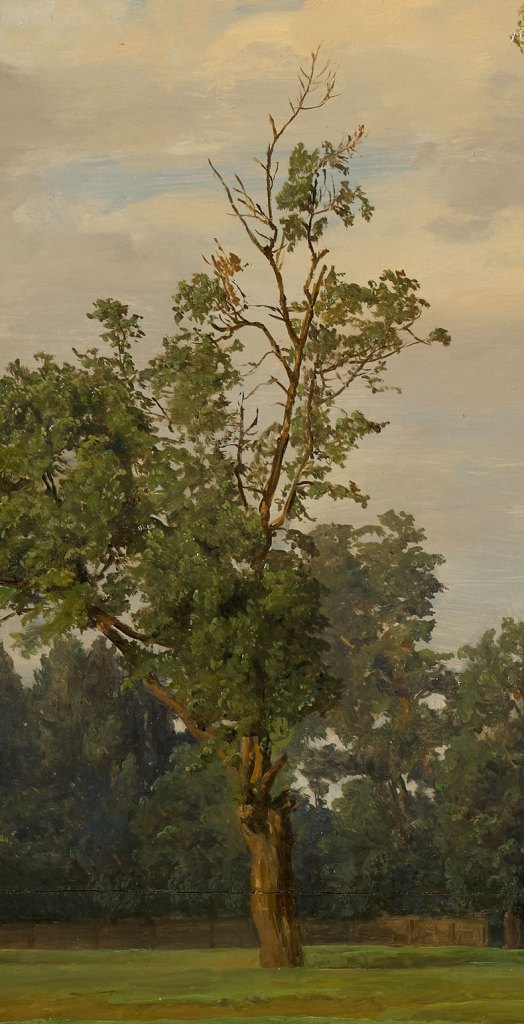
Most of all, Waldmüller was a great naturalist. His devotion to landscape painting came alive in the 1830s, when Waldmüller spent time away from Vienna, often in the Salzkammergut region, where the upper and middle classes would go on holidays and where he would paint striking views of mountains and lakes. When he was back in Vienna, however, he was painting nature closer to home. One subject he returned to repeatedly was the Prater, a large recreational park on the outskirts of the city, which Waldmüller would paint in oil, usually on wood panels, depicting individual trees or bushes with remarkable attention to detail. This is quite different from what came before Waldmüller – notably Caspar David Friedrich – and his contemporaries in Austria, such as the Nazarenes, who were painting in a much more Romantic style. Even Friedrich von Amerling, who along with Waldmüller is seen as the foremost Austrian painter of the Biedermeier period, tended to depict people in a more idealised way than Waldmüller did – the kinds of figures who look like they’ve been retouched in Photoshop. Waldmüller, always one to go his own way, was looking back to Dutch and Flemish painting: throughout the 1820s he painted copies of landscapes by Dutch 17th-century artists, most notably Jacob van Ruisdael, of whom Constable was also a great admirer.
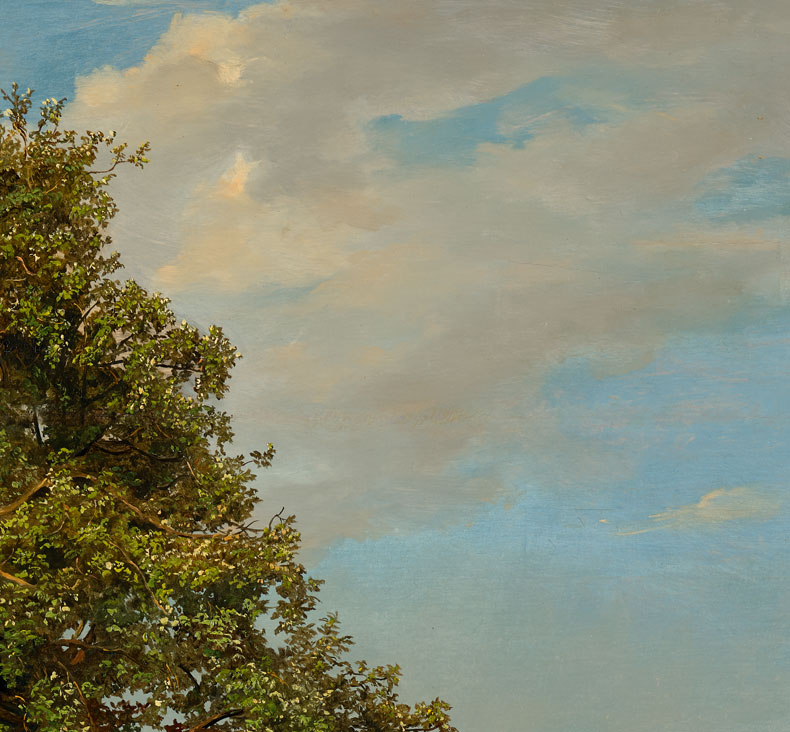
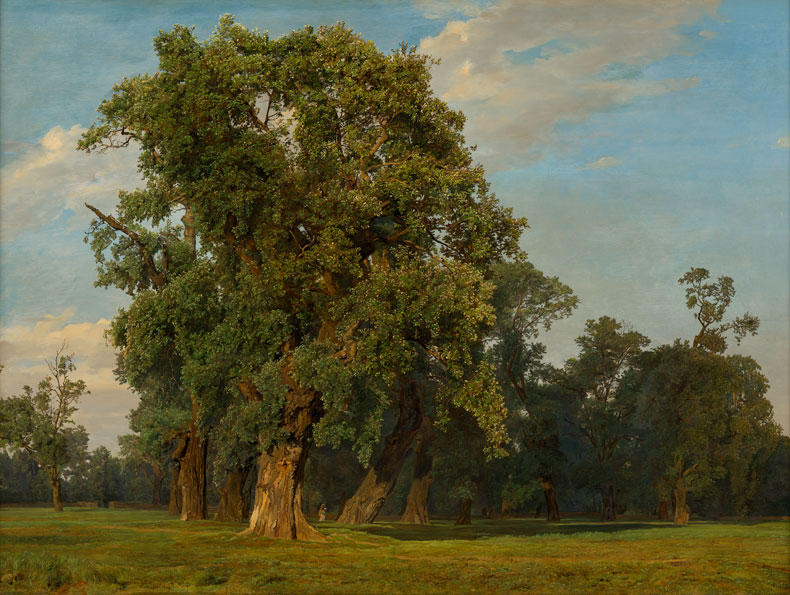
This painting, Large Prater Landscape, is one of Waldmüller’s depictions of the Vienna park, but it was painted in 1849, more than a decade after the flurry of Prater scenes that he produced in the ’30s. It is much bigger than those earlier works and, crucially, was produced at the end of a decade in which he had travelled to Italy – to Lake Garda and Venice in 1841 and then to Sicily three times between 1844 and 1846. He had always been interested in light and shade, but he became more sensitive to subtleties during his time in Italy, and you can see it here: the leaves of the tree (most likely a poplar) appear to move in the wind, with the sunlight hitting different parts of the leaves from all different sides. The sky, too, is just as you might see it in the Prater today, a muted blue with streaks of clouds. When Waldmüller depicts, for instance, a foggy landscape in the Salzkammergut, it’s not a Friedrich-style fog, alluding to another sphere, or a god, or some higher power, but a faithful representation of what he sees.
Back in those days the Prater was used in part as a hunting ground and a recreational space and, even in the 18th century, it was a draw for artists: Angelica Kauffman describes promenades along the Prater Allee in her diaries. But the corners of the park further out from the city were wilder and less built-up. We don’t know the exact spot from which Waldmüller painted this, but it must have been in that outer part of the park. Some of Waldmüller’s Prater scenes from the 1830s were painted, at least in part, in situ, which led later admirers of his work to brand him as a forerunner of the Impressionists, an early plein-air artist. This landscape, because it’s much bigger, was most likely begun in the Prater in sketches, before Waldmüller returned to his studio to start painting in oil on panel.
Whenever Waldmüller was painting landscapes, whether mountains or forests, the Dachstein or the Prater, he almost always included some kind of human presence – if not people then a hut, perhaps, or a little boat, largely as a way of demonstrating the idea of mankind’s harmony with the natural world. The figure in this painting is difficult to see at first: she is dwarfed by the tree. But look closely and you’ll see a tiny figure, which turns out to be a woman carrying wood. On the face of it, this is a way of showing scale, as he often did with the landscapes he produced in the 1830s. But it’s interesting that Waldmüller chose to depict a wood-gatherer in particular. At this time in Vienna, wood was still the main fuel for stoves and furnaces, so the authorities cut down a certain amount of wood from the lower branches of trees around Vienna, which the poor were allowed to go and collect.
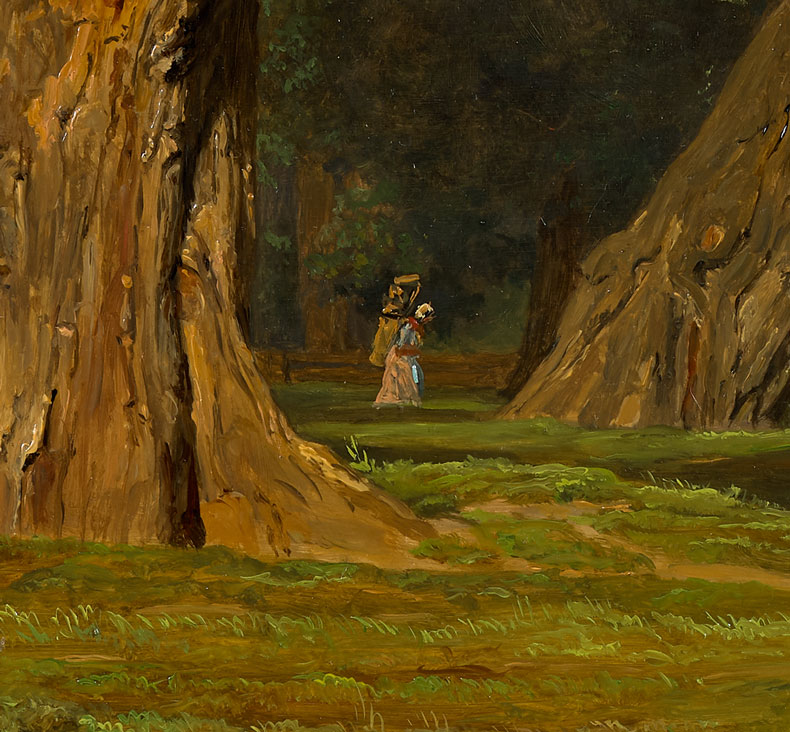
Waldmüller actually painted several larger depictions of wood-gatherers in the 1850s: he spent much of his time in the Viennese woods and was a close observer of people, so this detail is partly about simply painting what he saw. But there is also an argument that Waldmüller saw an admirable quality in poor figures – specifically in the notion that even those who are living on the edge of society can still enjoy the pleasures of the natural world, which is something that, Waldmüller thought, was starting to be taken for granted in 19th-century Austrian society. He was not, in the manner of Millet or Courbet, an artist who was deeply committed to drawing attention to the plight of the labouring classes, but he was certainly interested in trying to understand what life was like for the poor. In doing so, he could evoke sympathy for those less fortunate than the affluent collectors, living in beautiful apartments in Vienna, who could afford to have his paintings on their walls. Waldmüller stopped short of overtly reprimanding the bourgeoisie – they were the ones buying his art, after all – but he certainly wanted to make his audience stop and think.
It might seem odd that Waldmüller would witness the revolutions of 1848 and decide the following year that what he should be painting was a big tree in Vienna. But 1849 was the year that Waldmüller published another of his tracts, taking aim at the Academy, so this painting was also a way of making his point, loud and clear. Waldmüller’s relationship with the Academy never really recovered; in 1857 he was pushed into early retirement and the artist became embroiled in financial difficulties. In 1863, two years before his death, he organised a large auction of 87 works, which included the Large Prater Landscape. It didn’t sell; the next record we have of it is of appearing in the sale of the collection of Friedrich Jakob Gsell in 1872. At the turn of the 20th century the work was bought by the Eissler family, who were major collectors of Austrian and French art, before in 1912 it entered the collection of the Moderne Galerie (now called the Belvedere), where it has been ever since.
Waldmüller’s posthumous reputation is fascinatingly contradictory. Although he had fallen out of favour during his lifetime and in the immediate aftermath of his death, he was rediscovered and rehabilitated around the time of the Vienna Secession. It might be surprising that his works found favour with the avant-garde, but some hailed Waldmüller as a kind of proto-Secessionist, partly because of his deep interest in light and colour and partly because of his rebellious character. Indeed, many of the collectors buying his art were from Jewish backgrounds and were also buying work by Klimt, Schiele and other avant-garde artists, which makes it particularly interesting that, when Fascism took hold in Europe, Waldmüller (and Biedermeier art in general) was seized upon by the Nazis as a heroic chronicler of family ideals and national pride. After the Second World War, he was reclaimed by those who wished to instil a more positive sense of Austrian pride – one that rejected Nazism. Waldmüller’s reputation, in his lifetime and since, was marked by a succession of peaks and troughs. With this exhibition bringing his work to a new audience, we are surely entering another peak.
As told to Michael Delgado.
Arnika Groenewald-Schmidt curated ‘Ferdinand Georg Waldmüller: True to Nature’, which was at the Belvedere, Vienna, from 27 February–14 June. She is co-curator, with Sarah Herring, of ‘Waldmüller: Landscapes’, which runs at the National Gallery, London, from 2 July–20 September.
From the July/August 2026 issue of Apollo.


